Towards AI•about 17 hours ago·20 min read
LangChain Explained: Understanding Models, Prompts, Chains, Memory, Indexes, and Agents
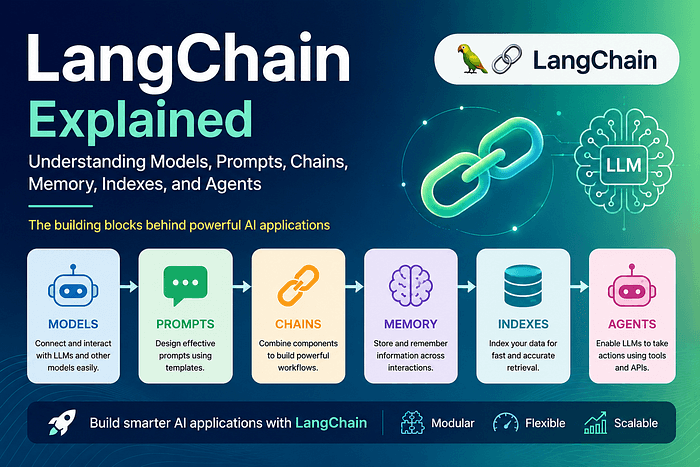
Last Updated on June 8, 2026 by Editorial Team Author(s): Atul Kumar Originally published on Towards AI. LangChain Explained: Understanding Models, Prompts, Chains, Memory, Indexes, and Agents Large Language Models (LLMs) such as GPT, Gemini, and Claude have made it easier than ever to build intelligent applications. However, developing production-ready AI systems often requires much more than simply calling an API. This is where LangChain comes in In this article, we’ll explore the core components of LangChain and understand why they are important. Introduction to Langchain : LangChain is an open-source framework that simplifies the development of applications powered by Large Language Models. It provides a collection of components that help developers connect LLMs with external data, memory, tools, and workflows. Benefits of LangChain: 1. Model Agnostic LangChain provides a unified interface for different LLM providers such as OpenAI, Gemini, and Claude. This makes it easier to switch models without rewriting large portions of code. 2. Reusable Prompt Templates Instead of hardcoding prompts, developers can create dynamic and reusable prompt templates, improving maintainability and scalability. 3. Simplified AI Workflows Chains allow multiple operations to be connected, making complex workflows easier to build and manage. 4. Context-Aware Applications Memory enables applications to remember previous interactions, creating more natural and personalized user experiences. 5. Efficient Knowledge Retrieval Indexes and vector databases allow applications to retrieve relevant information from large datasets, improving response accuracy. 6. Autonomous Decision Making Agents can dynamically decide which tools or actions to use, enabling the development of intelligent AI systems. 7. Faster Development LangChain provides ready-to-use components, reducing development time and allowing developers to focus on application logic rather than infrastructure. What Can We Build Using LangChain? 1. AI Chatbots Build conversational assistants capable of answering questions and maintaining context throughout a conversation. 2. Customer Support Systems Create intelligent support agents that can access company knowledge bases and provide accurate responses. 3. Retrieval-Augmented Generation (RAG) Applications Build systems that retrieve information from documents and use LLMs to generate context-aware answers. 4. Document Question-Answering Systems Allow users to upload PDFs, research papers, or reports and ask questions about their contents. 5. AI Agents Develop autonomous agents that can use tools, APIs, databases, and search engines to complete tasks. 6. Personal AI Assistants Create assistants that manage schedules, answer questions, summarize information, and perform actions on behalf of users. 7. Content Generation Tools Generate blogs, social media posts, emails, reports, and marketing content automatically. 8. Recommendation Systems Use embeddings and semantic search to recommend products, articles, courses, or videos. 9. Research Assistants Build AI systems that search, summarize, and analyze information from multiple sources. 10. Multi-Agent Systems Create multiple specialized agents that collaborate to solve complex problems and automate workflows. Components Of LangChain:- LangChain Components 1. Models Models are the core interfaces through which we interact with AI models. It is one of the core building blocks of a LangChain application. Problem: Different AI providers, such as Anthropic, OpenAI, and Google Gemini, use different SDKs and API formats. If you write code directly for one provider, switching to another often requires changing significant parts of your code. Solution: LangChain’s Model abstraction provides a common interface for interacting with different LLMs. Instead of writing provider-specific code, we write against LangChain’s standardized API. Models In LangChain 2. Prompts A Prompt is the fundamental text input or instruction provided to a Large Language Model (LLM). Problem: LLMs perform best when prompts are well — structured properly. But hardcoding prompts every time can lead to: Repeated code Inconsistent outputs Difficult maintenance Solution: The Prompt component in LangChain provides reusable and dynamic templates that insert user inputs into predefined instructions before sending them to the model. Prompting Techniques: Dynamic Prompting: Prompt changes based on user input or variable. Example of Dynamic Prompting Use Case: Personalised responses, Chatbots, AI Applications. 2. Role-Based Prompting: Assign a role or persona to the model. Example of Role based Prompting Use Case: Expert Advice, Tutoring, Coding Assistance. 3. Few-Shot Prompting: It provides an example so the model learns the desired pattern and generates the desired output for a new input. Example of Few-Shot Prompting Use Case: Classification, Extraction, Formatting Tasks. 3. Chains A Chain in LangChain connects individual components like prompts, LLMs, and output parsers into a seamless, automated workflow. Let Say, NLP Pipeline We can represent the flow using pipelines; if not, we have to manually take the output of one and push it as input to another Problem: Many GenAI applications require multiple steps, not just a single Large Language Model (LLM) call. Without chains, we would have had to manually connect all the steps. Solution: Chains connect multiple LangChain components into a single workflow, in which the output of one component becomes the input to the next. Types of Chains: Sequential Chain: Steps executed one after another. Parallel Chain: Multiple tasks run simultaneously. RAG Chain: Most common in Industry( Chat with PDF, Company Knowledge base) Types Of Chains 4. Memory Problem: By Default, “LLM API calls are stateless” means they do not remember previous conversations. Solution: Memory stores conversation history or important information and automatically provides it to the LLM when needed. How Memory Works? Working of Memory Types of Memory: Conversation Buffer Memory: Stores the entire conversation. Simple, but becomes large over time. Best for short conversations and prototyping. Conversation Buffer Memory 2. Conversation Buffer Window Memory: Limit memory to only the last K messages. Best for maintaining the recent conversational context while keeping the token usage predictable and preventing the context window from overflowing. 3. Summarize Based Memory: Periodically summarize older chat segments to keep a condensed memory footprint. 4. Custom Memory: For advanced use cases, we can store specialized state, e.g., the user's preference or key facts about them, in a common memory class 💡Key Takeaway: Choose the right memory type based on your use case, conversation length, and token limit to build an efficient and context-aware AI application. 5. Indexes Indexes in LangChain connect your application to external Knowledge, such as PDFs, […]